

dvLED is Leading the Way — What Does the Industry Say?
As direct-view LED (dvLED) technology reshapes the world of visual display, one thing has become increasingly clear: a screen is only as good as its installation. With dvLED walls growing in scale, complexity, and importance, mounting precision is more important than ever. At UNICOL, we support the AV industry with engineered mounting solutions that deliver on both technical and aesthetic fronts.
To better understand the evolution of dvLED, and the vital role mounts play, we spoke with five experienced professionals:
• Harry Harwood, Project Manager at Leyard Europe
• Ellie Kemshall, Channel Marketing Manager at LEDstudio
• Roy Martin, Director UK & Ireland at Hisense B2B Europe
• Dan Victory, Group Technical Director at GVAV Ltd
• James Pearson, Project & Technical Service at Willow Communications Ltd
"dvLED isn’t just about looking good—it’s about driving business." - James Pearson, Willow Communications
The Technical Edge of dvLED: Why It’s Gaining Ground
All contributors agree that dvLED brings significant benefits that continue to outperform LCD and projection in many scenarios.
“dvLED offers higher brightness, better contrast, and vibrant colour reproduction compared to LCD and projection systems,” explains Harwood. “It also has no bezels, allowing for seamless, large-scale displays, and it performs well even in bright environments. dvLED is more flexible in size and shape, making it ideal for custom and large-format installations.”
That flexibility and performance is echoed by Kemshall, who adds that “dvLED has a few key advantages. First, it’s self-emissive, so there’s no backlight or projection source -it just gives you direct light and colour. That means better contrast, deeper blacks, and brighter output, especially in high ambient light […]. Compared to projectors, you get better reliability, no lamp changes, and the image won’t degrade over time.”
Whilst for manufacturers like Martin at Hisense, dvLED tiles are “easy to service with lower energy consumption and longer life cycles.” This, along with lower energy and replacement costs, allows them to provide a more attractive installation option for those looking to be environmentally conscious.
Commercially speaking, Pearson concurs, adding that “they’re built to last. We’re talking 100,000+ hours of lifespan, which means fewer headaches down the line. Plus, colour and contrast stay consistent over time. That’s a huge bonus for brands that want to look sharp every day of the year.”
It’s clear to see why dvLED is the technology of choice in more installations - from seamless visuals to longer life cycles, the benefits are extensive.
Pixel Pitch: Precision That Pays Off
Pixel pitch remains one of the most influential factors in determining image clarity and installation suitability. It’s important to understand the effect that pixel pitch has on the overall image and how distance can affect the outcome.“Pixel pitch refers to the distance between each pixel,” explains Harwood. “Choosing the right pixel pitch depends on how far viewers will be from the screen and helps balance image quality with cost.”
Pearson adds that, “the smaller the number, the sharper the image - especially up close. So, for places like boardrooms or luxury retail, you’d want something under 1.5mm. If it’s a big open space like an airport or stadium, you can go higher - 2.5mm and up - because people are viewing from a greater distance.” Kemshall agrees, adding “it’s all about matching pitch to how far away people will be and the angle they’ll be viewing the screen from.”
To really define the ideal pixel pitch for your application, Victory recommends using AVIXA’s DISCAS calculations. By using the viewing distance, angle and content style you can assess the required resolution and image size. “This allows us to have meaningful discussions with our clients and confirm the suitability of a given solution with certainty.”
Mounting and Installation: Where Projects Succeed or Fail
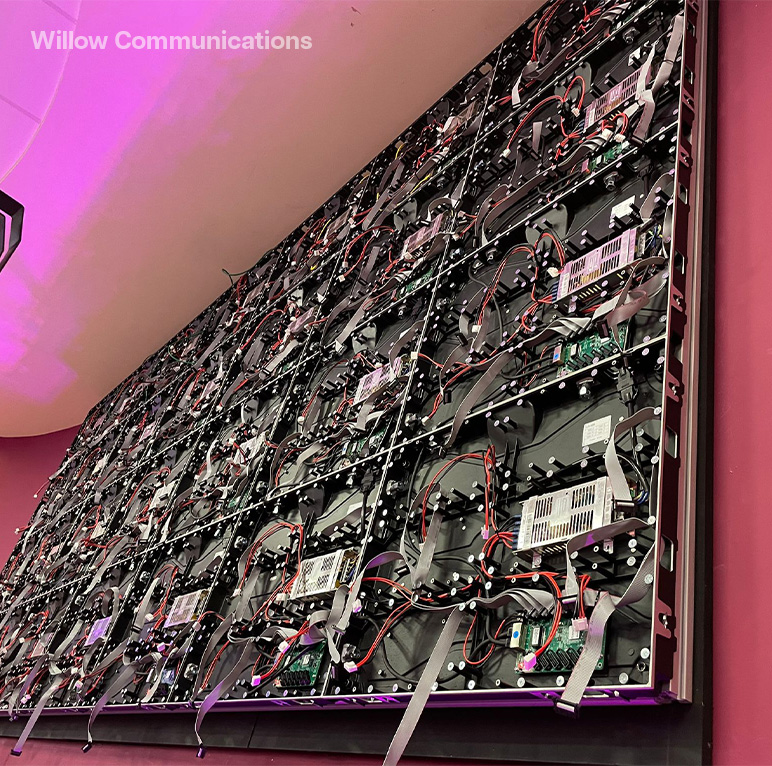
“The big one is structural accuracy,” warns Kemshall. “dvLED doesn’t forgive a misalignment […]. You can’t wing it. Everything needs to be thought through ahead of time.”“Getting the wall perfectly flat is a big one,” adds Pearson. “LED modules are precise - any tiny bump or curve can throw off the alignment.”
dvLED has no tolerance for installation shortcuts - structural accuracy is essential. It was unanimous that precision mounting was the number one technical challenge. This is where products such as UNICOL’s Spirit mount plays such a pivotal role, offering structure, flexibility, and peace of mind. By utilising precision-engineered aluminium extrusion, you’re getting the strength and accuracy regardless of the video wall size.
“Once you have defined the display solution which provides the overall dimensions and wiring methodology, the other aspects are generally the video processing (including the dvLED controller) and the physical and service requirements,” Victory further explains, highlighting the technical aspects of an installation.
“Cooling is something you can’t ignore either. LEDs generate heat, and without proper airflow, things can get messy fast,” adds Pearson. “Also, planning access for maintenance (front or rear) is crucial so you don’t have to dismantle an entire wall to fix one panel.”
By speaking to and utilising the expertise of AV integrators such as GVAV & Willow Communications or LED specialists like LEDstudio, you ensure that all queries, applications, technical challenges and more are thoroughly catered for.
dvLED Adoption: Where It’s Growing Fast
Demand is accelerating throughout the AV industry, we’re seeing dvLED utilised in all verticals and in many cases at a rapid rate.Harwood lists the top adopters as “retail, broadcast, corporate, transportation, education, and live events […]. dvLED is also growing in control rooms and high-end residential projects.”
Pearson agrees, acknowledging that retail has gone all-in and corporate and hospitality are also growing, too. Ultimately, he believes that dvLED is expanding its versatility; “anywhere that wants to engage people visually is turning to LED. It’s not just about displaying content anymore - it’s about creating an experience.”
Victory believes that the increase in demand across multiple markets, especially commercial and education, is due to dvLED technologies significant improvements. “The products available now perform extremely well and the gap from other solutions to dvLED is narrowing significantly, so what was impractical a few years ago is very achievable now."
Future Forecast: Will dvLED Replace LCD?
“We are seeing early stages of this,” states Martin, “and no doubt it will impact more and more in the coming years.”“dvLED is becoming more accessible and versatile across a broader range of projects,” explains Pearson. “As the cost per square meter continues to decline, we will likely see fewer large-format LCD displays being specified.” Kemshall concurs, expressing that “anywhere where quality and reliability are a priority, dvLED is replacing LCD.”
Unanimously, they all see LCD’s being the viable and popular option for small-screen and low-budget installations. Victory adds that for anything over 90” we will see “dvLED becoming the only solution.”
So, whilst dvLED is the increasingly popular choice, LCD screens will remain a widely accessible option that will be particularly prevalent in smaller, lightweight, lower-cost installations.
Sustainability: A Growing Priority
Sustainability and energy efficiency are an increasingly crucial part of the decision-making process, especially within the AV industry. With the growth of dvLED and the everchanging nature of technology, it’s fallen into place as the next technology to be increasingly evaluated through the sustainability lens. Kemshall and Pearson both acknowledge that it’s a much bigger part of the conversation than it was a few years ago. “The good news is LED has a long life, which already gives it an edge over tech that needs constant replacements,” explains Pearson.Martin, Director UK & Ireland at Hisense, notes that sustainability “is a subject covered on at least 50% of pre-sales.” This is further acknowledged by Harwood, Project Manager at Leyard Europe, who says that “dvLED manufacturers are responding with more efficient technology and greener materials. For many organisations, sustainability now plays a key role in the decision-making process.”
Integrators, additionally, are taking time to research and source technology that meets these needs. “We are spending a lot of time researching the overall power consumption and managing this on a day-to-day, hour-to-hour basis to ensure that the power usage is optimised,” explains Victory. “This is coupled with extensive reviews with our supply chain on the sustainability credentials of their products from cradle to grave to ensure we’re doing our part to provide the most effective, sustainable option.”
What Surprises Clients During Installation?
“Clients often don’t realise how precise the structure must be – small misalignments can affect the display,” starts Harwood. “Definitely,” agrees Kemshall, “structure precision is probably the one that catches people out the most. It’s easy to assume things will just line up, but even a slight misalignment can throw off the whole wall.”Misalignment isn’t the only thing that often surprises clients. Kemshall, Pearson and Harwood all agree that power demands are another common misconception. Pearson tells us that “we’ve also had situations where the building’s power couldn’t handle the system, and upgrades were needed. […] It’s all fixable – it just needs to be considered early.”
For Martin, these early considerations are the key; “one thing is to set expectations on resolution and content in non-standard installations. End user education is something that needs to be considered.” Following this train of thought, Victory rightfully notes that “it’s our job as integration partners to pre-empt any surprises and keep the client aware in advance of the considerations and necessary steps.”
However, one of the best client surprises, as Kemshall states, is that “once it switches on, it’s usually a bit of a ‘wow’ moment.”
Why UNICOL? Because Every Millimetre Counts
As has been acknowledged throughout this piece, dvLED is the star of the show, but the mount is what makes it work.
“UNICOL provided strong, accurate mounting that made the install smooth and visually clean,” says Harwood of a project in Oxford Street. “Their custom sliding solution helped keep everything aligned and ensured the system was serviceable and reliable - exactly what the client needed.”
Kemshall praises the adaptability of UNICOL; “having a UK-based partner who can engineer solutions to fit has been a real advantage. Their stuff is reliable, accurate and easy to work with.”
“UNICOL made things easy,” adds Pearson. “Their mounting solutions are rock solid and super precise, which is exactly what you need for a LED. […] Their custom options helped us match the aesthetic the client wanted, and access for service was built right in. In short, they helped us deliver a clean, professional install that made the client feel like they were getting top-tier value.”
The Future Is Bright—and Precisely Mounted
As dvLED continues to grow as the display technology of choice, the importance of structure, precision and flexibility grows too. At UNICOL, we work with all our customers to ensure that their LED wall installations deliver without compromise.
Need help with a dvLED installation? Get in touch with our supportive team today to see how we can support your next project.
Alternatively, you can find out more about our dvLED solutions here; unicol.com/spirit-dvled-video-wall-mount
dvLED is Leading the Way — What Does the Industry Say?
As direct-view LED (dvLED) technology reshapes the world of visual display, one thing has become increasingly clear: a screen is only as good as its installation. With dvLED walls growing in scale, complexity, and importance, mounting precision is more important than ever. At UNICOL, we support the AV industry with engineered mounting solutions that deliver on both technical and aesthetic fronts.
To better understand the evolution of dvLED, and the vital role mounts play, we spoke with five experienced professionals:
• Harry Harwood, Project Manager at Leyard Europe
• Ellie Kemshall, Channel Marketing Manager at LEDstudio
• Roy Martin, Director UK & Ireland at Hisense B2B Europe
• Dan Victory, Group Technical Director at GVAV Ltd
• James Pearson, Project & Technical Service at Willow Communications Ltd
"dvLED isn’t just about looking good—it’s about driving business." - James Pearson, Willow Communications
The Technical Edge of dvLED: Why It’s Gaining Ground
All contributors agree that dvLED brings significant benefits that continue to outperform LCD and projection in many scenarios.
“dvLED offers higher brightness, better contrast, and vibrant colour reproduction compared to LCD and projection systems,” explains Harwood. “It also has no bezels, allowing for seamless, large-scale displays, and it performs well even in bright environments. dvLED is more flexible in size and shape, making it ideal for custom and large-format installations.”
That flexibility and performance is echoed by Kemshall, who adds that “dvLED has a few key advantages. First, it’s self-emissive, so there’s no backlight or projection source -it just gives you direct light and colour. That means better contrast, deeper blacks, and brighter output, especially in high ambient light […]. Compared to projectors, you get better reliability, no lamp changes, and the image won’t degrade over time.”
Whilst for manufacturers like Martin at Hisense, dvLED tiles are “easy to service with lower energy consumption and longer life cycles.” This, along with lower energy and replacement costs, allows them to provide a more attractive installation option for those looking to be environmentally conscious.
Commercially speaking, Pearson concurs, adding that “they’re built to last. We’re talking 100,000+ hours of lifespan, which means fewer headaches down the line. Plus, colour and contrast stay consistent over time. That’s a huge bonus for brands that want to look sharp every day of the year.”
It’s clear to see why dvLED is the technology of choice in more installations - from seamless visuals to longer life cycles, the benefits are extensive.
Pixel Pitch: Precision That Pays Off
Pixel pitch remains one of the most influential factors in determining image clarity and installation suitability. It’s important to understand the effect that pixel pitch has on the overall image and how distance can affect the outcome.“Pixel pitch refers to the distance between each pixel,” explains Harwood. “Choosing the right pixel pitch depends on how far viewers will be from the screen and helps balance image quality with cost.”
Pearson adds that, “the smaller the number, the sharper the image - especially up close. So, for places like boardrooms or luxury retail, you’d want something under 1.5mm. If it’s a big open space like an airport or stadium, you can go higher - 2.5mm and up - because people are viewing from a greater distance.” Kemshall agrees, adding “it’s all about matching pitch to how far away people will be and the angle they’ll be viewing the screen from.”
To really define the ideal pixel pitch for your application, Victory recommends using AVIXA’s DISCAS calculations. By using the viewing distance, angle and content style you can assess the required resolution and image size. “This allows us to have meaningful discussions with our clients and confirm the suitability of a given solution with certainty.”
Mounting and Installation: Where Projects Succeed or Fail
“The big one is structural accuracy,” warns Kemshall. “dvLED doesn’t forgive a misalignment […]. You can’t wing it. Everything needs to be thought through ahead of time.”“Getting the wall perfectly flat is a big one,” adds Pearson. “LED modules are precise - any tiny bump or curve can throw off the alignment.”
dvLED has no tolerance for installation shortcuts - structural accuracy is essential. It was unanimous that precision mounting was the number one technical challenge. This is where products such as UNICOL’s Spirit mount plays such a pivotal role, offering structure, flexibility, and peace of mind. By utilising precision-engineered aluminium extrusion, you’re getting the strength and accuracy regardless of the video wall size.
“Once you have defined the display solution which provides the overall dimensions and wiring methodology, the other aspects are generally the video processing (including the dvLED controller) and the physical and service requirements,” Victory further explains, highlighting the technical aspects of an installation.
“Cooling is something you can’t ignore either. LEDs generate heat, and without proper airflow, things can get messy fast,” adds Pearson. “Also, planning access for maintenance (front or rear) is crucial so you don’t have to dismantle an entire wall to fix one panel.”
By speaking to and utilising the expertise of AV integrators such as GVAV & Willow Communications or LED specialists like LEDstudio, you ensure that all queries, applications, technical challenges and more are thoroughly catered for.
dvLED Adoption: Where It’s Growing Fast
Demand is accelerating throughout the AV industry, we’re seeing dvLED utilised in all verticals and in many cases at a rapid rate.Harwood lists the top adopters as “retail, broadcast, corporate, transportation, education, and live events […]. dvLED is also growing in control rooms and high-end residential projects.”
Pearson agrees, acknowledging that retail has gone all-in and corporate and hospitality are also growing, too. Ultimately, he believes that dvLED is expanding its versatility; “anywhere that wants to engage people visually is turning to LED. It’s not just about displaying content anymore - it’s about creating an experience.”
Victory believes that the increase in demand across multiple markets, especially commercial and education, is due to dvLED technologies significant improvements. “The products available now perform extremely well and the gap from other solutions to dvLED is narrowing significantly, so what was impractical a few years ago is very achievable now."
Future Forecast: Will dvLED Replace LCD?
“We are seeing early stages of this,” states Martin, “and no doubt it will impact more and more in the coming years.”“dvLED is becoming more accessible and versatile across a broader range of projects,” explains Pearson. “As the cost per square meter continues to decline, we will likely see fewer large-format LCD displays being specified.” Kemshall concurs, expressing that “anywhere where quality and reliability are a priority, dvLED is replacing LCD.”
Unanimously, they all see LCD’s being the viable and popular option for small-screen and low-budget installations. Victory adds that for anything over 90” we will see “dvLED becoming the only solution.”
So, whilst dvLED is the increasingly popular choice, LCD screens will remain a widely accessible option that will be particularly prevalent in smaller, lightweight, lower-cost installations.
Sustainability: A Growing Priority
Sustainability and energy efficiency are an increasingly crucial part of the decision-making process, especially within the AV industry. With the growth of dvLED and the everchanging nature of technology, it’s fallen into place as the next technology to be increasingly evaluated through the sustainability lens. Kemshall and Pearson both acknowledge that it’s a much bigger part of the conversation than it was a few years ago. “The good news is LED has a long life, which already gives it an edge over tech that needs constant replacements,” explains Pearson.Martin, Director UK & Ireland at Hisense, notes that sustainability “is a subject covered on at least 50% of pre-sales.” This is further acknowledged by Harwood, Project Manager at Leyard Europe, who says that “dvLED manufacturers are responding with more efficient technology and greener materials. For many organisations, sustainability now plays a key role in the decision-making process.”
Integrators, additionally, are taking time to research and source technology that meets these needs. “We are spending a lot of time researching the overall power consumption and managing this on a day-to-day, hour-to-hour basis to ensure that the power usage is optimised,” explains Victory. “This is coupled with extensive reviews with our supply chain on the sustainability credentials of their products from cradle to grave to ensure we’re doing our part to provide the most effective, sustainable option.”
What Surprises Clients During Installation?
“Clients often don’t realise how precise the structure must be – small misalignments can affect the display,” starts Harwood. “Definitely,” agrees Kemshall, “structure precision is probably the one that catches people out the most. It’s easy to assume things will just line up, but even a slight misalignment can throw off the whole wall.”Misalignment isn’t the only thing that often surprises clients. Kemshall, Pearson and Harwood all agree that power demands are another common misconception. Pearson tells us that “we’ve also had situations where the building’s power couldn’t handle the system, and upgrades were needed. […] It’s all fixable – it just needs to be considered early.”
For Martin, these early considerations are the key; “one thing is to set expectations on resolution and content in non-standard installations. End user education is something that needs to be considered.” Following this train of thought, Victory rightfully notes that “it’s our job as integration partners to pre-empt any surprises and keep the client aware in advance of the considerations and necessary steps.”
However, one of the best client surprises, as Kemshall states, is that “once it switches on, it’s usually a bit of a ‘wow’ moment.”
Why UNICOL? Because Every Millimetre Counts
As has been acknowledged throughout this piece, dvLED is the star of the show, but the mount is what makes it work.
“UNICOL provided strong, accurate mounting that made the install smooth and visually clean,” says Harwood of a project in Oxford Street. “Their custom sliding solution helped keep everything aligned and ensured the system was serviceable and reliable - exactly what the client needed.”
Kemshall praises the adaptability of UNICOL; “having a UK-based partner who can engineer solutions to fit has been a real advantage. Their stuff is reliable, accurate and easy to work with.”
“UNICOL made things easy,” adds Pearson. “Their mounting solutions are rock solid and super precise, which is exactly what you need for a LED. […] Their custom options helped us match the aesthetic the client wanted, and access for service was built right in. In short, they helped us deliver a clean, professional install that made the client feel like they were getting top-tier value.”
The Future Is Bright—and Precisely Mounted
As dvLED continues to grow as the display technology of choice, the importance of structure, precision and flexibility grows too. At UNICOL, we work with all our customers to ensure that their LED wall installations deliver without compromise.
Need help with a dvLED installation? Get in touch with our supportive team today to see how we can support your next project.
Alternatively, you can find out more about our dvLED solutions here; unicol.com/spirit-dvled-video-wall-mount
More from the Knowledge Hub
-
Advancements in LED display technology are dramatically changing how we communicate and engage in workplaces and retail environments. Whether enhancin...Read More
-
UNICOL, the innovative AV mount manufacturer, proudly announces the launch of Spirit™. This brand-new range of dvLED mounting solutions is engineere...Read More
-
LED displays are fast becoming the go-to solution for organisations seeking to enhance communication, engagement, and overall experience. With their b...Read More
-
UNICOL Engineering, a leader in audio-visual mounting solutions, has successfully supported a major nationwide LED video wall installation across mult...Read More